
Editors can help you with your academic references, as long as you have the source information:
- Title of the work
- Title of the source
- Author/ creator of the work
- url of material source
- Other helpful items are page numbers, dates…
Note: do not include urls to search engine results! Due to different individual algorithms on our PCs, we may never find the image on our own search engine results.
Suggested captions or attributions from Creative Commons
“Furggelen afterglow” by Lukas Schlagenhauf is licensed under CC BY-ND 2.0.
This is an ideal attribution because it includes the:
Author: “Lukas Schlagenhauf“—with a link to their profile page
Source: “Furggelen afterglow“—with a link to the original photo on Flickr
License: “CC BY-ND 2.0”—with a link to the license deed
How you attribute authors of the CC works will depend on whether you modify the content, if you create a derivative, if there are multiple sources, etc.
<Academic Best Practices …need info>
Attributions for Indigenous works #
Indigenous works are all copyrighted and protected by copyright. A general rule of thumb for using Indigenous works is to try to contact the creator of the work or a community/ estate representative, to discuss your intended use and how to attribute the material correctly. [expand]
BC Campus has included an excellent guide, Indigenization Guide: Aboriginal, Indigenous or First Nations? about using Indigenous terms and materials in your OER.
Currently, TRU <who?> is working on creating a repository of collected openly licensed Indigenous images and learning materials.
Important to Keep in Mind: #
- Linking attributions (to source and to CC license info) will not appear in printed format – only web. We get around this by including the information, including the URL in an academic reference at the end of the chapter or by including the full url of the license info after the hyperlinked license.
- References should be included for each section – it is hard for the reader to find the references in one long list at the end of the chapter or at the end of the book.
- Keep CC licensing information with the materials in the caption, or ensure that it is included with the media attributions.
- The automatic inclusion of the media attributions at the end of the chapter/ section are not in an academic format! (see example below).
E.g. we are using the following hybrid academic and suggested Creative Commons format in Christine Miller’s Human Biology OER textbook:
Attributions #
Figure 3.8.1
Chlorine_gas_in_high_concentration by Larenmclane on Wikimedia Commons, is used under a CC BY-SA 4.0 (https://creativecommons.org/licenses/by-sa/4.0/deed.en) license.

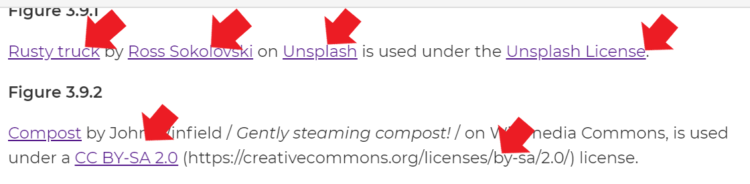
Note: we have hyperlinked the source url in the title, the creator page to the author, and the CC licence attribution. We’ve also included the url for the license information so that this info can be visible in printed format.
The default auto media attributions look like this:
Chlorine_gas_in_high_concentration by Larenmclane / CC BY-SA (https://creativecommons.org/licenses/by-sa/4.0) © CC BY-SA (Attribution ShareAlike)
- The default automated attributions will automatically appear at the end of your page (where the images appear) and only if you have added the metadata for each of your images. The default format is sufficient for copyright purposes, but it does not match academic styles.
- We are not including the license info / hyperlinks in the Figures for the Human Biology OER textbook – that information is in the attributions list, so that the Figure captions can have a more descriptive
Adobe Stock Images #
Most of our IDs have a paid education license access to Adobe Stock images. That Adobe license has attribution requirements. Here’s a recent example of how we’ve attributed those images:
Caption:
Breastfeeding/Chestfeeding Latch by Gegambar on stock.adobe.com
Citation:
Gegambar. (n.d.). The process of perfect baby breastfeeding latch [Stock image]. Adobe Stock. https://stock.adobe.com/images/the-process-of-perfect-baby-breastfeeding-latch/505615223?prev_url=detail
Artificial Intelligence (AI) Attribution #
Generative artificial intelligence (AI) tools are increasingly used to support editing, writing, image creation, coding, research, and other aspects of educational content development. Transparency regarding the use of these tools is an important part of scholarly and editorial integrity.
Caption:
Figure 5.2: Small campfire vs. large campfire. (OpenAI, 2025)
Citation:
OpenAI. (2025). Small fire vs. big fire illustration [Digital illustration]. ChatGPT. https://chat.openai.com/
UBC Library Guidelines #
UBC Library has developed extensive academic guidance for attributing/citing AI-created works for the major styles, APA, MLA, Chicago, etc.:
How to Cite – Generative AI – Research Guides at University of British Columbia
Attribution and Disclosure #
When generative AI has contributed to the development of course materials or other published content beyond routine editorial assistance, its use should be transparently acknowledged.
Editors should follow the current guidance provided by the University of British Columbia Library for citing and acknowledging generative AI tools.
UBC Generative AI Citation Guide
How to Cite – Generative AI (University of British Columbia Library)
Because guidance continues to evolve, editors should refer to the UBC resource rather than relying on static examples in this guide.